



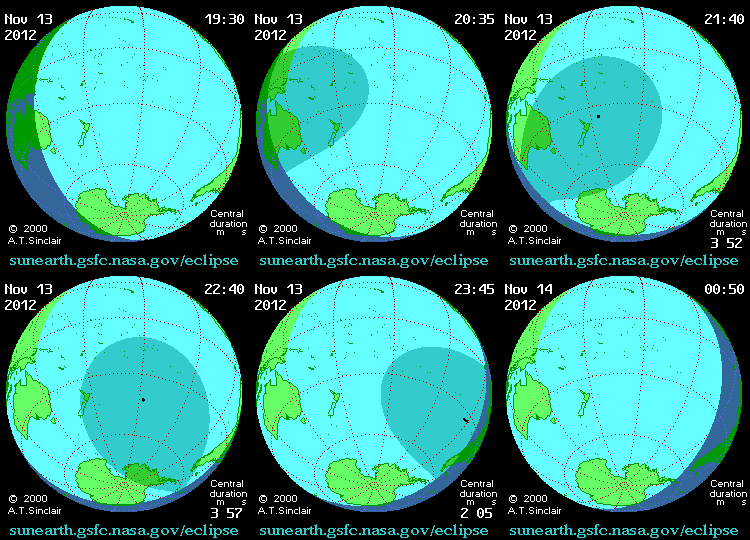
Yet one more solar eclipse! Well, this time it's gonna be a total solar eclipse. Maybe you're already in Cairns or almost there, or somewhere in the South Pacific, which are the places to be, to be able to witness this amazing celestial phenomena. As I blog this post from Sri Lanka, there are few more hours left until the start of this total solar eclipse. So we're just about there. As for me, and those who couldn't manage to be in the right places, there is this wonderful tool, Internet facilitating us to watch the eclipse online, as numerous groups bring out their own live streams of the eclipse, and updates. Believe it or not there's gonna be even a hot-air balloon offering a live webcast of the eclipse.
Thanks to Thilina Heenatigala of AWB now we can have a list of web-streams of the total solar eclipse.
Don't miss out !!
Cairns Solar Eclipse, 2012
http://www.eclipse2012.org.au
The official destination website for the total solar Eclipse over Cairns and Great Barrier Reef will feature Terry Cuttle from the Astronomical Association of Queensland as the host. He will be joined by Kate Russo (eclipse chaser and author), Ben Southall (winner of the 'Best Job in the World' promotion and tourism ambassador), Richard Fitzpatrick (an underwater cameraman, will be live from under water) and Alan Hale (from Hale-Bopp comet who is studying comets close to the Sun which can only be seen during an eclipse).
2012 Eclipse live from a Cairns Hot Air Balloon
http://www.hotair.com.au
Up to a dozen hot air balloons floating west of Cairns, Queensland Australia, with visitors from 20 different countries will be part of a live webcast of the 2012 total solar eclipse.
SLOOH
http://events.slooh.com
SLOOH will broadcast a free, real-time feed of the stunning total solar eclipse live from Cairns, Australia. The broadcast team includes Patrick Paolucci, Bob Berman, Lucie Green, Matt Francis and Paul Cox.
Cairns City Eclipse 2012 webcam
http://www.eclipsecairns.com
Can't make it to Cairns to see the Eclipse? No problem! Just check back on 14 November before 6:39am AEST (GMT+10) to see it live on our webcam.
GLORIA Project
http://live.gloria-project.eu
Videos and pictures of the eclipse will be broadcast live on the internet starting at 20:30 UT. Additionally meteorological data will be collected to allow students to perform an interactive experiment. During the broadcast there will be live commentary in Spanish and English.
Live Web Camera from Port Douglas Australia 2012
http://www.zincportdouglas.com/solar_eclipse_port_douglas.html
Thanks to Thilina Heenatigala of AWB now we can have a list of web-streams of the total solar eclipse.
Don't miss out !!
Cairns Solar Eclipse, 2012
http://www.eclipse2012.org.au
The official destination website for the total solar Eclipse over Cairns and Great Barrier Reef will feature Terry Cuttle from the Astronomical Association of Queensland as the host. He will be joined by Kate Russo (eclipse chaser and author), Ben Southall (winner of the 'Best Job in the World' promotion and tourism ambassador), Richard Fitzpatrick (an underwater cameraman, will be live from under water) and Alan Hale (from Hale-Bopp comet who is studying comets close to the Sun which can only be seen during an eclipse).
2012 Eclipse live from a Cairns Hot Air Balloon
http://www.hotair.com.au
Up to a dozen hot air balloons floating west of Cairns, Queensland Australia, with visitors from 20 different countries will be part of a live webcast of the 2012 total solar eclipse.
SLOOH
http://events.slooh.com
SLOOH will broadcast a free, real-time feed of the stunning total solar eclipse live from Cairns, Australia. The broadcast team includes Patrick Paolucci, Bob Berman, Lucie Green, Matt Francis and Paul Cox.
Cairns City Eclipse 2012 webcam
http://www.eclipsecairns.com
Can't make it to Cairns to see the Eclipse? No problem! Just check back on 14 November before 6:39am AEST (GMT+10) to see it live on our webcam.
GLORIA Project
http://live.gloria-project.eu
Videos and pictures of the eclipse will be broadcast live on the internet starting at 20:30 UT. Additionally meteorological data will be collected to allow students to perform an interactive experiment. During the broadcast there will be live commentary in Spanish and English.
Live Web Camera from Port Douglas Australia 2012
http://www.zincportdouglas.com/solar_eclipse_port_douglas.html

